In the rarefied world of haute horlogerie, a quiet revolution is unfolding—one that challenges the very foundations of watchmaking tradition. For centuries, the process has been unequivocal: first, the case, then the movement. The chassis was designed, and the mechanical heart was engineered to fit within its predetermined confines. This was the unspoken dogma, the industry's immutable law. But now, a cadre of visionary maisons is boldly inverting this equation, embarking on an audacious journey where the movement is no longer an afterthought but the genesis of creation. This is the era of the gem-set movement, a paradigm where the engine dictates the form, and the exterior world of gemstones is sculpted in harmonious response.
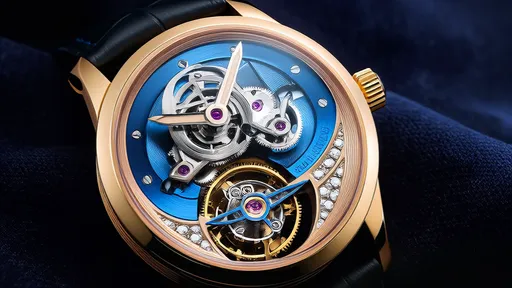
The philosophy is as radical as it is simple: begin with the soul. Watchmakers are now designing and assembling the movement first—a complex, intricate universe of gears, springs, and levers. This meticulously finished mechanism, often bearing Geneva seals or other marks of exceptional craftsmanship, becomes the absolute centerpiece. Only after this mechanical masterpiece is complete does the process of encasement begin. Artisans, gem-setters, and designers then collaborate to conceive a shell that does not merely contain the movement but celebrates it, frames it, and dialogues with it. The case, the lugs, the bezel, and the bracelet become a canvas for precious stones, but their placement, cut, and selection are all in service to the masterpiece within.
This "inside-out" methodology demands an unprecedented level of synergy between disciplines that have historically operated in sequence. The movement constructor can no longer work in isolation. Their creation must be envisioned with its future jeweled attire in mind. Will the bridges offer a stunning backdrop for light to play upon? Can the balance wheel be framed like a star on a stage? These questions must be answered during the movement's design phase. Conversely, the gem-setters and designers must possess a profound understanding of horology. Their art is no longer just about maximizing sparkle or value per carat; it is about architectural integrity, weight distribution, and, most importantly, creating windows and vistas that offer breathtaking views into the mechanical ballet ticking below.
The technical hurdles are immense. Precious metals and gemstones are unforgiving materials. Designing a setting that securely holds hundreds of stones without compromising the structural integrity of the case, while also ensuring it doesn't interfere with the crown, pushers, or the winding of the movement, is a feat of micro-engineering. Furthermore, the process of setting stones onto a fully assembled movement requires a steady hand and a dust-free environment of almost surgical sterility. One errant speck of dust or a misplaced tap of a tool could jeopardize the entire, painstakingly assembled calibre. This makes the final act of encasement the most nerve-wracking moment in the watch's creation.
This approach fundamentally redefines the concept of value in a high jewelry timepiece. Traditionally, a jeweler's value was often judged by the carat weight and quality of stones on the dial and bezel. The movement, while important, was sometimes a secondary consideration—a reliable, off-the-shelf engine powering a glittering exterior. The reverse thinking philosophy shatters that notion. Here, the value is intrinsically linked to the symbiosis between the mechanical art and the decorative art. The stones enhance the mechanics, and the mechanics give profound purpose to the stones. A diamond isn't just a diamond; it is a prism amplifying the beauty of a hand-beveled bridge. A sapphire crystal case back isn't an option; it is a non-negotiable window to the true soul of the piece.
The result is a new genre of watch that is more organic, more cohesive, and infinitely more captivating. These timepieces feel alive. Light doesn't just reflect off the surface; it travels through layers of gemstones, dances across polished anglage, catches the blue of a screw, and gets lost in the depth of an engraved rotor. They are kinetic sculptures, changing their character with every subtle turn of the wrist. The boundary between the technical and the artistic dissolves completely, creating a holistic object where every single component, from the smallest pinion to the largest emerald, is part of a singular, glorious vision.
In conclusion, this reverse thinking is more than a novel design technique; it is a philosophical statement. It declares that the greatest luxury is not opulence for its own sake, but the perfect, harmonious marriage of supreme technical mastery and sublime artistic expression. It places the watchmaker's craft back on the pedestal it rightly deserves, not as a hidden service provider but as the co-author of beauty. By building the gemstone shell around the mechanical heart, these avant-garde creators are not just making watches; they are composing symphonies in metal and light, proving that true innovation often comes from turning convention inside out.
By /Aug 27, 2025

By /Aug 27, 2025

By /Aug 27, 2025

By /Aug 27, 2025

By /Aug 27, 2025
By /Aug 27, 2025

By /Aug 27, 2025
By /Aug 27, 2025
By /Aug 27, 2025

By /Aug 27, 2025

By /Aug 27, 2025

By /Aug 27, 2025
By /Aug 27, 2025

By /Aug 27, 2025
By /Aug 27, 2025

By /Aug 27, 2025
By /Aug 27, 2025

By /Aug 27, 2025
By /Aug 27, 2025
By /Aug 27, 2025
