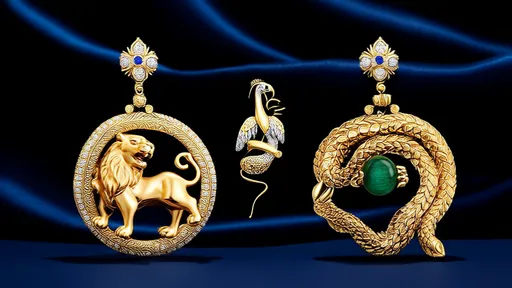
Throughout human history, jewelry has served not only as adornment but as a profound medium for storytelling and cultural expression. Among the most enduring motifs are those drawn from the animal kingdom, with creatures like the lion, the serpent, and the peacock recurring across civilizations. These are not merely decorative choices; they are rich with layered meanings, myths, and messages that vary fascinatingly from one culture to another. The symbolism embedded in these animal forms transforms a piece of jewelry into a talisman, a status symbol, or a narrative piece, speaking a silent language understood across time and geography.
Perhaps no animal embodies a more universally recognized power than the lion. Across numerous cultures, it stands as the undisputed king of beasts, a symbol of raw courage, noble authority, and majestic strength. In ancient Egypt, the lion was sacred to the fierce goddess Sekhmet, a deity of war and healing, whose power was both creative and destructive. Pharaohs, who were seen as living gods, often incorporated lion imagery into their regalia—from headdresses to thrones—to project their divine right to rule and their invincibility in battle. The great Sphinx of Giza, with the body of a lion and the head of a pharaoh, is perhaps the most monumental testament to this fusion of human leadership and leonine power.
Moving eastward, the lion's symbolism takes on protective qualities. In many parts of Asia, particularly in China, lion statues guard the entrances to temples, palaces, and homes, warding off evil spirits and negative energy. This guardian role is seamlessly transferred to jewelry. A pendant or brooch featuring a lion is not just a display of bravery; it is an amulet, a piece of armor meant to protect the wearer from harm and misfortune. Similarly, in the Greco-Roman world, the lion was associated with heroes like Hercules and was a symbol of solar power and resurrection. This multifaceted symbol, whether etched into a signet ring or set in gold as a pendant, carries with it an aura of command and security that has resonated for millennia.
In stark contrast to the lion's solar magnificence, the serpent slithers through the undercurrents of mythology with a potent and deeply ambivalent symbolism. Its ability to shed its skin has made it an almost universal emblem of rebirth, transformation, and eternal life. This is powerfully illustrated in the ouroboros—the ancient symbol of a snake eating its own tail—which represents the cyclical nature of existence: life, death, and rebirth. In ancient Egypt, the cobra, or uraeus, was worn on the crown of the pharaoh as a symbol of sovereignty, divine authority, and protection. It was believed to spit fire at the king's enemies, making it a formidable symbol of defended power.
Yet, the serpent also carries a heavy burden of negative connotations, largely due to its role in Abrahamic traditions. In the Biblical story of Genesis, the serpent is the cunning tempter who brings about the fall of man, thus becoming synonymous with deception, sin, and the devil himself. This duality makes serpent jewelry incredibly complex. A Victorian-era snake ring, coiled around the finger, could simultaneously symbolize eternal love (due to its never-ending form) and dangerous temptation. In other cultures, such as those in Mesoamerica, the feathered serpent god Quetzalcoatl was a creator deity associated with wind, wisdom, and life itself. Therefore, a piece of jewelry featuring a snake is never just a snake; it is a conversation between healing and poison, wisdom and cunning, eternity and mortality.
Then there is the peacock, a creature that seems to have been designed by nature purely for spectacle. Its most immediate symbolic association is with vanity and pride, owing to its magnificent, eye-spotted tail feathers that it fans out in a dazzling display. This interpretation is common in Western art and literature, where the peacock can represent narcissism and unchecked arrogance. However, to reduce its meaning to mere vanity is to overlook its profound spiritual significance in other parts of the world.
In Hinduism, the peacock is the vahana, or sacred mount, of the god Kartikeya, the god of war, and also associated with the goddess Lakshmi, a bringer of prosperity and good fortune. Its feathers are considered sacred and are used in rituals to cleanse spaces of negative energy. More importantly, in the eyes of many Eastern cultures, the "eyes" on the peacock's tail are seen as the all-seeing eyes of the gods, offering protection and wisdom. In Persian and Byzantine cultures, the peacock was a symbol of immortality and the cosmos. The belief was that its flesh did not decay after death, making it a powerful emblem of resurrection and eternal life. A piece of peacock-inspired jewelry, with gems mimicking the iridescent blues and greens of its plumage, is thus a wearable piece of cosmic protection and a celebration of beauty's divine nature.
When these symbols are crafted into jewelry, the material and style further refine their meaning. A lion rendered in rough, untreated gold suggests primal, ancient power. The same lion carved delicately in jade speaks to protective, guardian energy in East Asian traditions. A serpent ring woven from sleek, silver strands evokes a sleek and mysterious allure, perhaps hinting at wisdom and rebirth. That same serpent crafted in gold with ruby eyes might lean into its associations with temptation and passion. A peacock pendant with vibrant enameling and inlaid sapphires celebrates divine beauty and protection, while a more abstract, Art Nouveau peacock feather hairpin might simply capture the aesthetic wonder of nature's design.
Ultimately, these animal motifs on our rings, necklaces, and brooches are far more than decorative art. They are a silent language, a dense shorthand for the values, fears, and aspirations of the cultures that cherish them. The lion offers us strength and protection, the serpent offers us transformation and a warning, and the peacock offers us beauty with a purpose that transcends vanity. To wear them is to participate in an ancient dialogue, connecting the wearer to a deep, shared human history of finding meaning in the natural world. They remind us that jewelry has always been, and will always be, a form of storytelling worn on the body.
By /Aug 27, 2025

By /Aug 27, 2025

By /Aug 27, 2025
By /Aug 27, 2025

By /Aug 27, 2025
By /Aug 27, 2025
By /Aug 27, 2025
By /Aug 27, 2025
By /Aug 27, 2025
By /Aug 27, 2025

By /Aug 27, 2025
By /Aug 27, 2025
By /Aug 27, 2025
By /Aug 27, 2025
By /Aug 27, 2025
By /Aug 27, 2025
By /Aug 27, 2025

By /Aug 27, 2025
By /Aug 27, 2025
By /Aug 27, 2025
